


Container Terminal Lighting
Certainly — here is a 500-word English description of Container Terminal Lighting, with no company names included:---Container Terminal LightingContainer terminal lighting plays a vital role in the safe, efficient, and continuous operation of modern ports. As one of the most important elements of port infrastructure, lighting ensures that container handling activities can be carried out reliably during nighttime hours, in low-visibility conditions, and in all kinds of weather. A well-designed lighting system improves productivity, enhances safety for workers and equipment, and supports round-the-clock terminal operations.Container terminals are large, complex environments with high levels of activity. Cranes, trucks, straddle carriers, reach stackers, and other heavy machinery move constantly across the yard. In such a setting, proper illumination is essential to reduce the risk of accidents and to help operators perform precise tasks. Good lighting allows drivers and crane operators to clearly identify containers, lanes, signage, and pedestrians. It also helps security personnel monitor the terminal and detect unauthorized access or suspicious activity.Modern container terminal lighting systems are designed with several key factors in mind. First, they must provide sufficient brightness across wide areas such as quays, storage yards, and access roads. Second, the lighting must be uniform, avoiding dark spots and excessive glare that could distract operators or reduce visibility. Third, the system should be energy efficient, as terminal lighting often operates for many hours every day. For this reason, LED technology is widely used because it offers high luminous output, long service life, low maintenance requirements, and reduced energy consumption compared with traditional lighting sources.Another important consideration is durability. Container terminals are exposed to harsh marine environments, including salt spray, strong winds, humidity, dust, and vibration. Lighting fixtures used in these areas must be resistant to corrosion and capable of operating reliably under demanding conditions. Poles and mounting structures must also be engineered to withstand heavy weather and provide stable support for high-mast lighting installations. In many terminals, tall masts are used to illuminate large zones from a single point, reducing the number of poles needed and maximizing coverage.Smart lighting control systems are becoming increasingly common in container terminals. These systems can adjust brightness levels according to operational needs, time of day, or weather conditions. Motion sensors, remote monitoring, and automated scheduling help reduce energy waste while maintaining a safe working environment. In addition, intelligent controls make it easier to detect maintenance issues and ensure that lighting performance remains consistent.Beyond safety and efficiency, container terminal lighting also contributes to sustainability. By using energy-saving fixtures and control technologies, terminals can reduce carbon emissions and operating costs. Improved lighting design can also minimize light pollution, protecting surrounding communities and ecosystems.In summary, container terminal lighting is a critical part of port operations. It supports safety, productivity, security, and sustainability in one of the most demanding industrial environments. With advances in lighting technology and intelligent control systems, modern terminals can achieve better performance while lowering energy use and maintenance costs.---If you want, I can also make it:1. more technical,2. more marketing-oriented, or3. simpler and easier to read.
Products
Category:
-
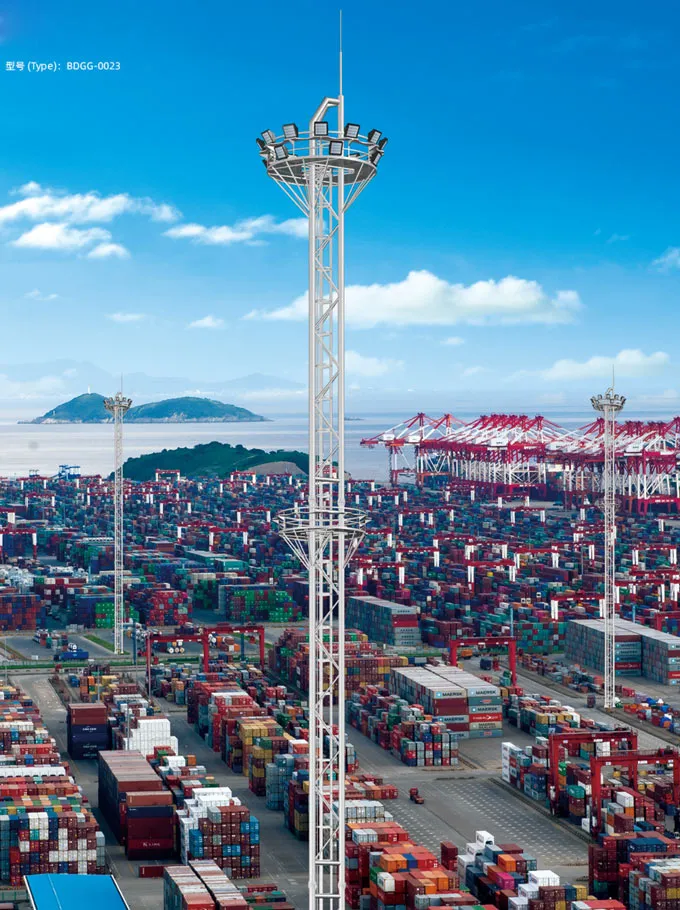
Port High Mast Floodlight Tower
Category: High Mast LightsBrowse number: 554Number:Release time: 2026-08-18 14:44:28The Port High Mast Floodlight Tower is designed for large-scale illumination in container terminals, cargo yards, logistics zones, wharfs, and other port facilities. Its truss-type tower structure supports multiple high-mounted LED floodlights, maintenance access, and project-specific lighting arrangements for wide operational areas. Floodlight quantity, beam distribution, tower height, platform structure, corrosion protection, electrical control, and foundation design can be customized according to the port project.
Blog
Category:
-
[Lighting Technology & Guides]Container Terminal Lighting: Key Planning Factors
2026-09-24 13:29:13
Solutions & Projects
Category:
No search results found!
Video
Category:
No search results found!
Download
Category:
No search results found!
Job
Category:
No search results found!
Featured Products
No search results found!



 Phone